Automobile parts are some of the most demanding products to package. They're heavy, irregularly shaped, frequently oily or coated, and a single scratch on a finished surface can render a part unsellable. Add long export journeys and rough handling, and the margin for error disappears.
Here's how purpose-built corrugated packaging keeps auto components safe — and warranty claims down.
The four challenges of auto-part packaging
- Weight. Engine parts, brake discs, transmission components and castings are dense. The box and inserts must carry real load without collapsing.
- Shape. Few parts are box-shaped. Shafts, brackets, hoses and housings need packaging that holds them in place.
- Surface protection. Machined and painted surfaces scratch, and bare metal corrodes. Contact points must be cushioned and, often, moisture-controlled.
- Stacking & export. Parts ship by the pallet, often internationally, and sit in warehouses for months.
Build the box for the load
Heavy components call for double-wall or triple-wall corrugated board. Triple wall, in particular, has become a popular replacement for wooden crates: it carries comparable loads, weighs far less (lowering freight cost), is recyclable, and avoids ISPM-15 fumigation requirements for timber in exports.
Use partitions and inserts — not loose fill
Loose void fill lets heavy parts shift and bang together. Engineered partitions, layer pads and die-cut inserts are what actually protect auto components:
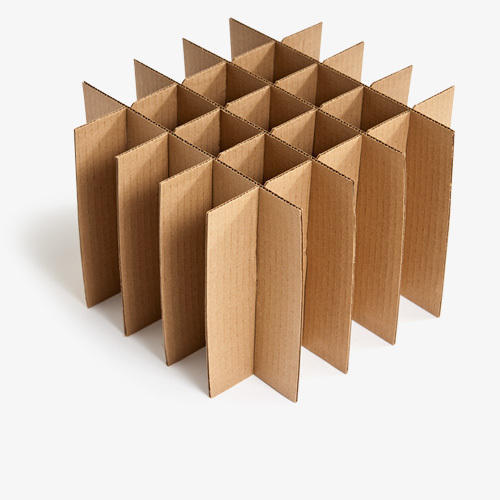
- Corrugated partitions / dividers keep multiple parts separated so they can't collide.
- Die-cut cradles and trays hold a part in a fixed position, distributing load and preventing movement.
- Layer pads let you stack multiple tiers safely inside one box.
- Edge and corner protectors guard finished surfaces and reinforce the box corners — the first thing to fail under stacking.
Don't forget corrosion and oil
Bare and machined metal needs protection from moisture:
- VCI (Volatile Corrosion Inhibitor) paper or liners release a protective vapour that prevents rust during long transit.
- Absorbent or oil-resistant liners contain residual lubricants so they don't soak and weaken the board.
Label and standardise for the supply chain
Auto supply chains run on traceability. Consistent box sizes, clear part-number labelling, and stackable footprints make handling faster, improve pallet cube, and reduce errors at goods-in.
The payoff
Get auto-part packaging right and you reduce transit damage, warranty returns and corrosion claims — while often cutting freight cost by moving from timber to engineered corrugated. Get it wrong and a scratched casting or a rusted shaft turns into a rejected shipment.
Oriental Enterprises engineers heavy-duty boxes, partitions and inserts specifically for the automobile sector. Tell us about your components and we'll design packaging that protects them end to end.